Two bids land on a building owner’s desk for the same job. The first is a quote for commercial painting services from an outside crew, and the second is a rough estimate for handling the work in-house. The in-house number almost always looks smaller at first glance. That is where the comparison gets slippery. The price on the page is not the same as the cost of the project. So before you wave off a commercial painting contractor to save a line item, look closer. It helps to see what each path really adds up to.
This is a straight comparison, not a sales pitch. Hiring out is not always the right answer, because sometimes it isn’t. The goal here is to hand you the real math, the real risks, and a simple way to decide for your own building.
Key Takeaways:
The Real Decision Behind the Two Numbers
A building owner is not in the paint business. You are in the business of keeping a property full, safe, and worth what you paid for it. Paint is just one tool for that. So the real question is not “who paints it.” The real question is “what protects the building and my time best, for the money.”
Here is the honest part. In-house painting can be the right call. A maintenance tech touching up a stairwell or a back office on a slow afternoon is a smart use of payroll. The math changes fast, though, once the job gets big, gets high off the ground, or has to happen on a tight schedule. That line is what this comparison is really about.
The worry under all of this is simple. Nobody wants to overpay. Nobody wants to pick the wrong crew, watch the work peel in a year, and pay for it twice. That concern is fair, and it cuts both ways. A bad outside hire costs money. So does a stretched-thin in-house attempt that skips prep and has to be redone.
What In-House Painting Really Costs
The in-house quote looks cheap because most of the cost is hidden. Your crew is already on payroll, so the labor feels free. It is not.
Painting is skilled work. According to the Bureau of Labor Statistics, the median wage for painting and coating workers was about $40,860 in 2024. When your maintenance team picks up a roller, you are paying that kind of labor rate. Meanwhile, the building’s other work piles up. The leaky faucet, the HVAC filter, the tenant request: all of it waits in line behind the paint job.
Then there is the gear. Commercial jobs need sprayers, lifts, scaffolding, and the right primer for each surface. Renting a lift for a two-story exterior is not cheap, and buying one makes no sense for a job you do once every few years.
Prep is where in-house painting usually slips. A trained crew spends a big share of the job cleaning, sanding, patching, and priming before any color goes on. Skip that step, and the coat fails early. Commercial interiors often need a repaint every three to five years as it is. Cut corners and you are back at it sooner, paying again.
Add it up. Payroll hours, lost maintenance time, rented equipment, and the risk of a redo. The “free” option starts to cost real money.
Where a Commercial Painting Contractor Changes the Math
A commercial painting contractor prices the whole job, not just the paint. That quote folds labor, prep, equipment, and cleanup into one number you can plan around. Reliable commercial painting services bundle every one of those pieces into that single bid. No guessing, no creeping costs halfway through.
For exterior work, the numbers are public. Commercial painting cost data is easy to check before you ever take a call. Painting a commercial building’s exterior commonly runs from $5,500 to $18,500. Most projects land near $12,000, based on national figures from HomeAdvisor. That sounds like a lot next to “free.” But it buys speed, a crew that does this every single day, and a finish built to last the full repaint cycle instead of half of it.
Speed matters more than most owners expect. A trained crew with the right sprayers covers ground fast and plans around your tenants and your hours. That scheduling flexibility is one quiet advantage of commercial painting services: the work bends around your building, not the other way around. Less downtime for the building often means the real cost gap is far smaller than the two bids suggest.
The Liability Nobody Puts in the In-House Estimate
This is the part the in-house number leaves out completely.
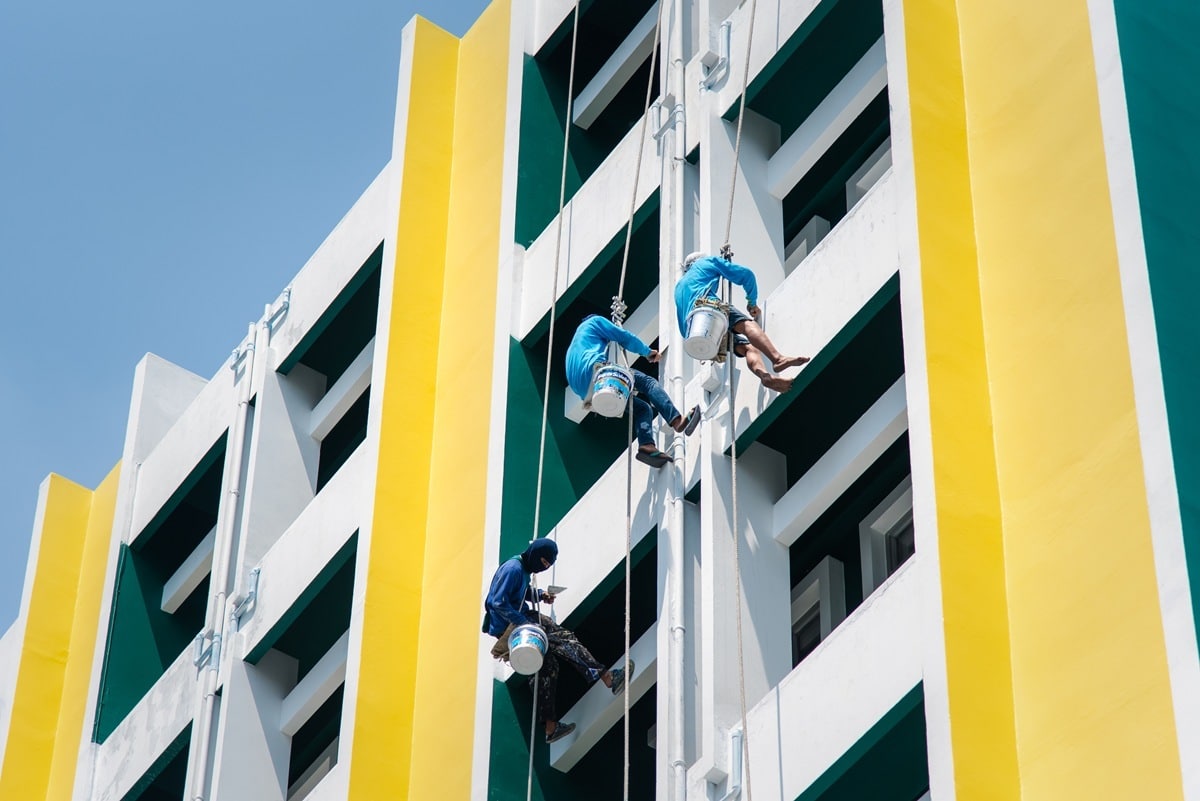
Most commercial painting happens off the ground. Once work passes six feet, OSHA’s fall protection rules apply. Fall protection has been the most-cited violation in construction for fourteen years running. If your own employee falls off a ladder while painting your building, that becomes your liability, your workers’ comp claim, and your headache.
A licensed commercial painting contractor carries its own insurance and trains its crew for height and safety codes. You are not just buying paint. You are moving real risk off your books and onto a company built to carry it. That single fact flips a lot of in-house decisions on its own.
How to Decide: A Simple Test
You do not need a spreadsheet. Run the job through four plain questions.
If your answers lean small, low, flexible, and low-stakes, in-house painting can work just fine. If they lean large, high, urgent, or high-stakes, the comparison stops being close. At that point a commercial painting contractor earns its quote.
What Hiring Commercial Painting Services Looks Like
Good commercial painting services do not start with a brush. They start with a walk-through. A real contractor measures the space, checks the surfaces, asks about your hours, and writes a clear scope. You should walk away with a line-item quote, a timeline, proof of insurance, and a plan for working around your tenants.
That transparency is the differentiator worth looking for. You are not paying for vague promises. You are paying for a fixed scope, a set schedule, and a crew that owns the result. Ask any commercial painting contractor for references, a license number, and a written warranty on the work. The companies that answer those questions fast are the ones worth a second call. That holds whether you land on full commercial painting services or a smaller in-house plan.
Make the Smart Call for Your Building
You own the building. You get to make the call. But you deserve to make it with the full picture, not just the smaller-looking number on the page.
If your project is large, high off the ground, or on a clock, talk to Paint Pro's NW first. Loop us in before you hand it to the maintenance crew. We work with building owners across Gig Harbor, WA. You get clear quotes, licensed and insured crews, and a written scope you can hold us to. No vague estimates. No surprise add-ons partway through.
Call Paint Pro's NW at 425-671-9074 for a free walk-through and a line-item quote on your commercial painting project. See the real number, set it next to your in-house option with eyes open, and pick the path that fits. The right call protects both your building and your time.